
Data centers are vital to our digital ecosystem, and while the Uptime Institute acknowledges that fire incidents are rare, their impact can be devastating.
For instance, consider the recent fire at a Kakao data center in South Korea. The company is facing the possibility of losing billions and incurring increased costs during recovery.
As you can see, though such incidents are rare, the problems they can cause are significant. For these reasons, we have collected all the important statistics on fire incidents in data centers. This way, you can make a data-driven decision when safeguarding your data center.
Data Center Fire Key Statistics
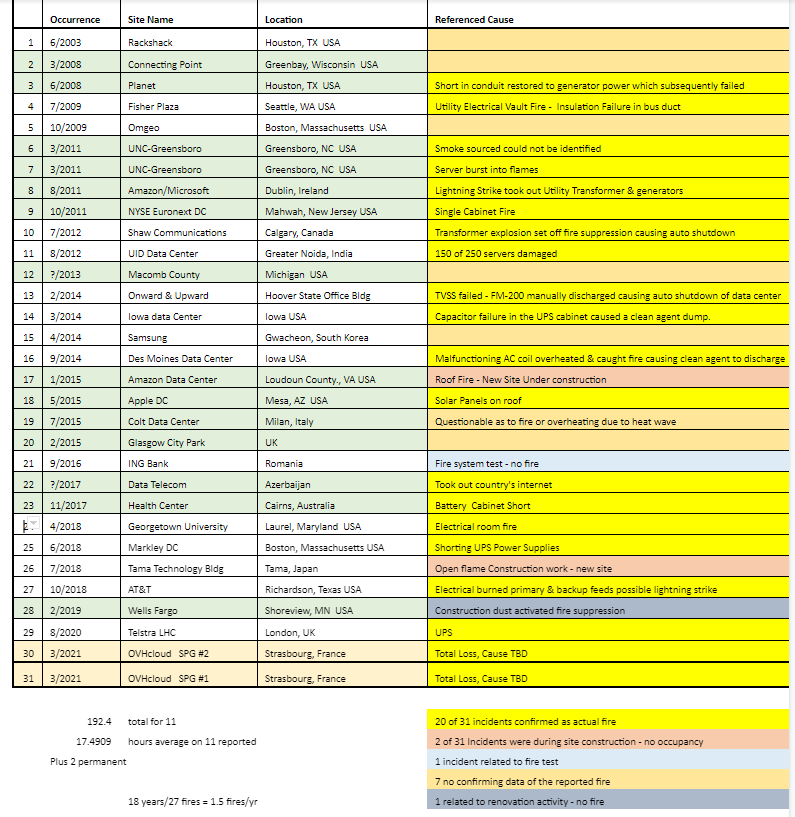
In the span from June 2003 to March 2021, a duration of 18 years, Data Center Dynamics identified a total of 31 fire incidents in data centers.
Source: Data Center Dynamics
Based on the provided image:
- A majority, being 65 percent or 20 incidents, were verified as actual fires.
- About 23 percent, or 7 events, were reported as fires but lacked verification.
- New data centers still under construction accounted for 6 percent or 2 incidents.
- In one instance, making up 3 percent, construction dust triggered the fire suppression system in an operational data center.
- Another single event, also at 3 percent, involved a disruption caused by testing of the fire suppression system.
These figures suggest an annual average of approximately 1.5 significant fire incidents at data centers.
Main Causes of Data Center Fires
While specific research on data center fire causes is lacking, we can reference general workplace fire data from the Office of Fire Marshal and Emergency Management.

Source: All Protect
Notably, ‘heating and cooling’ and ‘wiring’ are common ignition sources. Given their extensive use in data centers, these factors are assumed to be significant contributors to fires in such facilities.
Data Center Fires Vs Downtime
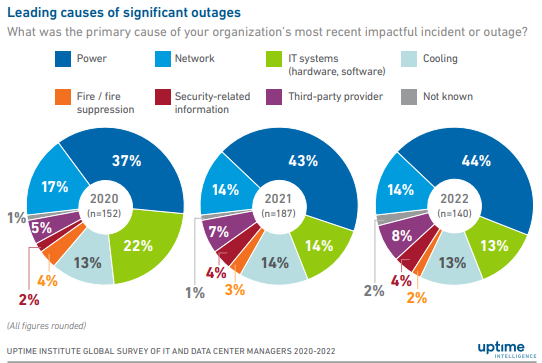
Though the impact of data center fires can be significant when they do occur, the frequency of such events as a cause of outages is relatively low. In fact, data center fires are not among the most common reasons for downtime.
Source: Upwork Intelligence
The statistics between 2020 and 2022 reveal that fires were responsible for an average of only 3% of all data center outages. Encouragingly, this figure has halved since 2020, indicating an improvement in fire prevention and safety measures within these critical facilities.
Data Center Fire Suppression Best Practices
Effective fire suppression is critical to protecting data center assets and ensuring business continuity. While detection systems serve as your first line of defense, a well-designed suppression strategy determines whether a small incident remains contained or escalates into a catastrophic event.
Choose the Right Suppression Agent
Traditional water-based sprinkler systems present a serious problem for data centers. Water and sensitive electronic equipment simply do not mix. A sprinkler activation that successfully extinguishes a small fire can simultaneously destroy servers and networking equipment worth far more than the fire itself would have damaged.
For this reason, modern data centers have largely moved toward clean agent suppression systems. FM-200 and Novec 1230 are among the most widely adopted solutions, as both gases work by absorbing heat energy faster than the fire can generate it. They disperse quickly, leave no residue, and are safe for occupied spaces. Novec 1230 offers the added benefit of an exceptionally low global warming potential for environmentally conscious organizations.
Inert gas systems using nitrogen and argon provide another option. These reduce oxygen concentration to levels that cannot sustain combustion while remaining safe for humans. Though they require larger storage capacities, they have zero environmental impact.
Integrate Suppression with Detection and Zoning
Fire suppression works best when paired with early detection technology like VESDA, which can identify smoke particles before visible flames appear. This integration enables faster response times and can trigger suppression before a fire spreads.
Equally important is implementing zoned suppression rather than facility-wide systems. When a fire breaks out in one section, there is no reason to discharge expensive agents throughout the entire building. Zoning mi
Top Ways to Protect Against Data Center Fire Risks
According to research conducted by the Uptime Institute, the best practices to avert and safeguard against data center fires include:
- Detection: Use VESDA systems for early smoke detection.
- Suppression: Install fire barriers and maintain fire suppression systems. Consider ANSUL® clean agent systems, which use chemical agents instead of water to protect sensitive electronic equipment from collateral damage.
- Mitigation: Conduct regular risk assessments to address vulnerabilities.
Why ANSUL® Fire Suppression Systems Are Ideal for Data Centers
ANSUL® fire suppression systems offer a critical advantage for data center protection through their use of chemical agents rather than water.
Water-based sprinklers create a secondary disaster in data center environments. While they may extinguish flames, they simultaneously destroy the servers and networking equipment you are trying to protect. The recovery costs following water discharge often exceed the fire damage itself.
ANSUL® systems eliminate this risk. Their clean agent solutions suppress fires rapidly while leaving no residue on sensitive equipment. The agents interrupt combustion at a molecular level, extinguishing fires without collateral damage. Once the threat is neutralized, your equipment remains intact and operational, dramatically reducing downtime and recovery costs.
Protecting Your Data Center Investment
While data center fires are relatively rare, their potential impact cannot be underestimated. Data centers are the backbone of our modern digital infrastructure, and as such, it is imperative that they implement comprehensive fire prevention, detection, and suppression strategies to mitigate risks.